Wednesday, January 29, 2014

Neila Rey, Illustrated Workouts, Programs, Challenges and Nutrition Tips!

What a great site and visual representation of hundreds of workouts. Neila Rey has done an amazing job, visualizing no-weight workouts, meaning you can do this all in the comfort of you house with no gym equipment. Who ever illustrated the movements did a wonderful job and who ever came up with the names for some of the workouts did a great job.

Did I mention this is all free, you can donate and I would recommend doing so.

Enjoy..

Individual no-equipment workouts are added almost every week. To keep things fresh, you can either pick one at random or use a filter at the bottom of the page to find a workout that will suit you more, depending on whether you would like to lose weight or/and define muscle tone. These are all tested routines, some of them are harder than others, some are themed and Sci-Fi inspired and some are more to the point. You have plenty of options you can choose from. Don't forget to read the manual
Try not to stay with one routine for too long or your body will adjust and optimise to it and you’ll stop seeing results. I suggest you pick 3-4 different workouts per week and perhaps pick up a challenge to stay committed.
Challenges are designed to keep you accountable and help you stay motivated. Some of them have targets like getting to 50 push-ups in a month and others are there to help you supplement your training. If you don’t know where to start or you have never tried working out at home before, taking up a challenge is a good way to help your body adjust for daily exercise. 
There are no rest days in my challenges, but some days are easier than others to compensate for that. I believe it is more important to stick to something continuously rather than take a break and then give up on the whole thing. Stay committed and just do what you can, rest times are guidelines only - you don’t have to kill yourself if you can’t go on any further, just keep on showing up every day. Unless specified otherwise, the amount of reps is per day and is a total, you don’t have to do everything in one go. That way you can work at your fitness level. 
Programs are complete sets of daily routines. Currently I have 30 Days of Change [30DOC] and 90 Days of Action [90DOA] available for a free download. The main difference between the two is that the 30 Days of Change requires you do a lot of walking, jogging and running outside and the 90 Days of Action has all at-home cardio routines and challenges. So it depends on what kind of program you are looking for and what fits your lifestyle better, both will help you get in better shape and tone up, both come with cardio, strength and ab routines and have been thoroughly tested by me personally and by a group of volunteers. I also have a few running programs if it’s something you would like to try. 
Tips & Motivation is a collection of practical posts to help you begin your journey and then stay on track. Since I am not looking for clicks and I am not selling ads on this website, I only post material I myself find useful and worth reading. 
Nutrition is the edible extension of the tips and motivation section. That’s where I post all of the nutrition and healthy eating tips. 
Recipes section is the newest addition to the website. When you train you don’t have the time or the energy to cook and you end up with all the wrong things on your plate. So my goal is to test and come up with the best healthy, quick and easy, but affordable recipes that anyone can do. I only post recipes I myself make on a regular basis and I would recommend to my friends. 

Friday, January 24, 2014

Zipi: magnetic earbud strap

Now most still wear ear buds while training, not sure why but if you are going to get a Zipi! it helps you take the buds out of your ears and have them dangle around your neck, reach down and there they are. Zipi makes your earbuds simply disappear into the background when they are not needed. Zipi is an earbud strap that connects behind your neck using magnets.
Zipi uses neodymium magnets, the strongest magnets on the market.  Zipi comes in translucent white, yellow, aqua, hot pink and black. Zipi KickStarter Campaign

Thursday, January 16, 2014

16 Supposedly Healthy Foods With More Sugar Than A Snickers Bar

We try and try, looking for healthy food, or food that we think is healthy, only to find out it is not, to a point. Check this list out! Really, the problem with sugar is that it just makes you crave more sugar. When sugar enters your body, it causes the chemical serotonin to be released, which triggers your brain’s reward center and makes you feel more relaxed. That’s fine; the problem is that constantly eating too much sugar dulls this feel-good response so it takes larger amounts of sugar to get there — meaning the more you eat, the more you need. Full List

 Chobani Black Cherry Blended Yogurt: 28 grams sugar

Chobani Black Cherry Blended Yogurt: 28 grams sugar
Where the sugar comes from: black cherries, evaporated cane juice, cherry juice concentrate
Turns out, fruit-flavored yogurts are sweetened with more than just fruit. Shapiro’s thoughts: “I’m not a fan of the fruit-flavored yogurts, because they do have a ton of added sugar. Yogurt has naturally occurring sugar from the lactose, so that added sugar is just extra.” A better bet is eating unsweetened yogurt with fresh fruit on top. Stephanie Middleberg, M.S., R.D., C.D.N. of Middleberg Nutrition, agrees: “If you’re adding sugar, you really only should be having a teaspoon at a time.” That’s far more than the 7 teaspoons of sugar in Chobani’s Black Cherry Blended yogurt.

Monday, January 6, 2014

Bikestock, Vending Machine!


Being shocked is rare today, but having this type of machine out and about is again, simply Brilliant! What else can you say, set up these around any small town and I am sure it would be a big hit.

Bikestock seeks to empower people to ride their bikes. When we ride we feel alive, fulfilled and engaged in our communities and know others feel the same way. To that end we are dedicated to addressing the obstacles of riding and making it easy to solve minor emergencies any time of day. Bikestock provides support for urban cyclists through a network of vending machines, toolkits, and branded cycling products. By making self-service bike repair available around the clock, Bikestock aims to encourage more people to ride their bicycles. Bikestock locations fill in critical gaps in traditional bike shops business hours, while enhancing existing infrastructure. Cyclists have become a permanent and prominent feature of New York City roads. 200,000 people now ride daily on over 250 miles of bike lanes. Don’t let complications like flat tires or unanticipated rainstorms keep you from riding. Bikestock’s network of conveniently placed machines and toolkits will put essential products and tools within reach of cyclists.
BikeStock

Wednesday, December 4, 2013

Zozi and Bear Team Up! Go Get Your Bear On!

Get points, get gear and a ridiculous low rate. This is similar to the Marlboro promotion in the late 80's.
Here is my link: http://zozi.me/1bIFEmZ

Monday, November 25, 2013

Swim Training vrs. Run Or Bike!

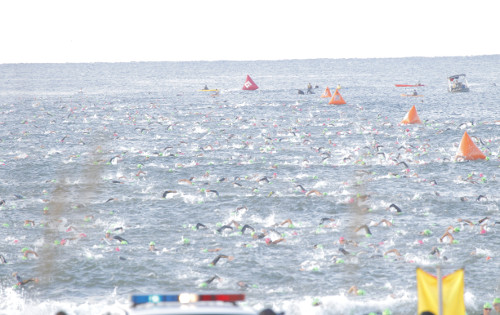
Now I have always taken off the months between October and January, even slowed down on the running and biking. I would start my training in January, with running and a lot of indoor biking. The biking is where one can make up a lot of ground, running is where the race is won. So swimming, what should one do... Beginner, Intermediate, Advanced. I am not sure, from this article I am one of the 10% been swimming since birth, the past couple years I have dramatically reduced the time I have spent in the water.
TriFuel sums it up..

Swimming holds a unique space in triathlon. It’s the shortest of all three distances on race day, yet it often holds the highest level of stress. From our perspective as coaches, swimming is also the most costly training activity you can engage in. For these reasons, we strongly recommend that you implement a swimming ban in the winter and focus your swim training within the final 20-26 weeks leading up to your “A” race.
More @ TriFuel

Calf Problems, Might Not Be The Shoes!

Runners World has a great article on calf muscles cramping up and the causes.
Cramping in the calves has several causes, but the true cause is not fully understood. Your history will likely give the most clues. True muscle cramps involve intense muscle contraction and the muscle needs to be lengthened to resolve the spasm. This differs a bit from calf pain from causes other than cramping that results in muscle spasm.
Exercise-related cramps are likely caused by muscle fatigue and may involve the Golgi tendon bodies, which normally fire to inhibit the muscle from contracting too hard. If the Golgi body fatigues, the nerve input to the muscle is overstimulated and the muscle cramps. This is an oversimplified explanation of a rather complex interaction proposed in the late 90s by Martin Schwellnus from South Africa. This may also be the cause of a “Charlie horse” type of cramp that strikes in the night or when sitting with the calf in a shortened position after an exercise bout. (I used to get them on the bus ride home from away track meets.) 

Tuesday, November 19, 2013

14 Workout Mistakes!

The 14 Biggest Weight-Training Mistakes

The science around strength training has changed in the last decade. You’re older, stronger, and hopefully, smarter now. Don’t make the same mistakes you made in your high school weight room.

Thursday, November 14, 2013

Buyers Guide for Cyclocross

From RCUK
We’re in the midst of the cyclo-cross season: knobbly tyres, mud, cow bells, beer and frites take over from September to February.

Cyclo-cross racing is, in our opinion at least, one of the most accessible forms of competitive cycle sport, with a packed calendar of mass start, first-across-the-line-wins local league races up and down the country. MORE>>>

Friday, November 8, 2013

Ultra's, So Your Thinking Of Going Big!

Gear Patrol, really gets it right! From ramping up, to training, nutrition, etc...
An estimated 60,000 people finished an ultra in the U.S. in 2012, up from about 10,000 in 1990. That number is still small compared to the 487,000 people who completed a marathon in the U.S. in 2012, but it’s still an awful lot of people running exceptional distances. The sport has been bolstered by author-athletes like Dean Karnazes (Ultramarathon Man: Confessions of an All Night Runner), Scott Jurek (Eat and Run) and Christopher McDougall (Born to Run: A Hidden Tribe, Superathletes, and the Greatest Race the World Has Never Seen). Pros are pulling down sponsorships from serious outdoor companies like New Balance and Salomon; The North Face sponsors a series of high-profile ultra runs with growing purses and a competitive pool; mainstream media are starting to cover races. There’s a growing interest in the exceptional.
And now you’re thinking about toeing the line for an ultra. Good for you. We’ve got a handy guide to help you through, complete with advice from a few pros at the top of the sport. Here’s a preview: it’s going to be hard work, but well worth the trouble.

Wednesday, October 30, 2013

HeadStrong Posture Trainer, Simple & Perfect!


So many different techniques to get the body in alignment while swimming, do this drill, try this method, etc.. 

Headstrong™ was invented to help athletes achieve their maximum potential while swimming. It gives insight to proper head position and aids in the correction of total body posture. Headstrong™ is a training tool like fins, paddles, or buoys... designed to aid in the development of your skill level.
With its patent pending technology, Headstrong™ delivers continuous "real-time" feedback while you train. With this innovative training device, you now have the unique ability to easily correct your head position leading to a more efficient stroke. Headstrong™ is made of HDPE which is chlorine resistant and UV resistant. Headstrong™ works for all types of swimming techniques - Freestyle, Breast or Butterfly stroke. Swimmers can also wear the device to provide a focal point... which is especially helpful for doing the backstroke. It was developed for male and female triathletes and swimmers training at any skill level. It's design uses "range-of-motion" to alert athletes of their head position and is completely undetectable to the swimmer until head position exceeds the recommended posture range. Headstrong™ took years of conceptual thinking, research, development and testing to perfect. Headstrong™ is a "one-of-a-kind" tool designed for swimmers, by swimmers. We are excited to be able to offer you the latest in swim training. Our goal is to help athletes become better athletes. Start getting the results you are searching for.
HeadStrong posture Trainer

Tuesday, October 29, 2013

CrossFit, Ironman Meets the California Bear!


Crossfit is many things to many different people, the one thing that stands out story after story is the ones about broken athletes. Yes they know how to train, which helps them not get injured, but doing CrossFit to re-build themselves is amazing, going from unable to move or compete to a functional and competitive athlete again!
In 1985, Chris Hinshaw finished the Ironman in second place, and at the peak of his career, he was one of the best triathletes in the world. But years of endurance training left him brittle and barely functional.
Today, at 50 years old, Hinshaw runs a 4:58 mile.
“The only thing that I’m doing differently is adding CrossFit. That’s it,” he says. “I’m not only functional, I can do things that I could never have imagined myself doing even back when I was a triathlete, back when I was one of the best in the world at it.”
Hinshaw trains at NorCal CrossFit, home of Jason Khalipa, who placed second at this year’s CrossFit Games. Khalipa credits Hinshaw with helping him get to the podium.
“He’s just like the Rich Froning of running to me,” Khalipa says of Hinshaw.
For his part, Hinshaw has equally complimentary words for the 2008 Games champion.

“Look at him,” he says as Khalipa begins a track workout. “This is his fifth mile. Fifth mile. Jason Khalipa, 220-lb. man, sub-six-minute pace.”

Free Download

Wednesday, October 2, 2013

Bike Frame Build, Price $-$$$$

from Gear Patrol
For a long time options for buying a bike were limited to what was at the local shop, which was a roll of the dice in terms of selection and service. In many ways, the manufacturer-distributor business model is antiquated and direct-to-consumer sales are the way forward. With e-commerce consumers have limitless information available at a mouse click. What does this mean for the bike buyer? You have options.
Purchasing a bike online used to be nigh impossible, but sites like Competitive Cyclist and Wrench Science are making it easy and worthwhile to get a high-quality ride off the web. However, if you’re in the market for a performance bike, it’s still expensive. Luckily e-commerce has also allowed for inclined customers to buy individual components. The wonders of a global marketplace also mean that in some instances you can buy components online from reputable European shops for less than your local bike shop can get them wholesale.
This availability opens the door for a bike purchasing option that didn’t really exist until the last 10 years: riders can now build their bike piecemeal, purchasing each individual component either new from online retailers or used from auction sites and classifieds. The result is a bike that can be built entirely outside of the bike shop system and that can be tailor-made to fit your specific wants and needs. That’s a recipe for high quality at low cost — so long as you know what you’re looking for.
With the experience of working in a bike shop under my belt and a good idea of what type of bike I wanted, I decided to try the “internet bike build” myself. With a budget of $2,000 I set out to best some of the similarly priced complete bikes for sale at the local shop.

Tuesday, October 1, 2013

Sub 2 Hour Marathon!

Is the sub-2 hour marathon imminent?  Don't hold your breath!
From Science of Sport!

Yesterday Wilson Kipsang took 15 seconds off the marathon world record, running 2:03:23.  It triggered, as it always does, talk of how close they are to breaking the two-hour barrier.  But that's very, very premature.  For reasons of physiology, performance evolution, and the inter-connectedness of performances from 10km to the marathon, we are a long, long way from going under two hours. 

It's not the same as for you or I, who find ourselves a few minutes outside a barrier, and know that six months of hard training and a good day will break it.  This is a world where the margins are tiny - that's why we can look at the pacing strategy and the splits and comment that perhaps it was a little too fast in sections, when in reality, "too fast" means 1 second per kilometer, accumulated over 20 minutes!  The precision of the physiology to run a 2:03 is extra-ordinary.

So consider for instance the progression.  In the modern era, catalyzed by da Costa's breaking of Dinsamo's 1988 record, the improvements in the record are as follows:
23 seconds, 4 seconds, 43 seconds, 29 seconds, 27 seconds, 21 seconds, 15 seconds.

This record is not going to be "smashed" by anyone.  Anything greater than 20 seconds is a big improvement. 
More...

Tuesday, September 24, 2013

Running Injury Free, Success, Secrets, Be Patient!

From Jason Fitzgerald is a 2:39 marathoner and USATF-certified running coach at Strength Running. Get his latest coaching advice and free injury prevention course here.
It isn't hard to get started running, but once you get into the swing of things, it's easy to injure yourself or ignore little things that make you a lot better. Running coach Jason Fitzgerald shares some of his secrets.

Hindsight is 20/20. As I look back on nearly 13 years of competitive racing, I want to change a lot of my past training. I made a lot of mistakes—small decisions that resulted in an injury, a poor race, or missing half a year of running.P

Many of my injuries can be attributed to impatience and a feeling of invincibility. I refused to reduce a training run by a few miles and I skipped the strength exercises. My carelessness showed with my constant battle with injuries. Achilles tendonitis, lower back pain, ITBS, shin splints, quadriceps strains – I had it all (with the exception of a knee injury, knock on wood!).P
No longer. These days, I’m fanatical about the little things and it’s paying off: I haven’t had a major injury since 2009! As I’m writing this, it’s been over two months since my last day off. I’m on track to run over 3,700 miles in 2011. That’s over 20% more than 2010.P
I want you to learn from my mistakes so you can be the best runner possible. “Do as I say, not as I do” seems appropriate for this post. Without further ado, below are the 7 things I wish I knew when I started running.P

Success in Distance Running Takes TimeP

A lot of time. Greg McMillan tells his elite runners that it takes 2-3 years to start seeing their potential. This amount of time is on top of their high school and college running years—so it’s really about 10 years. Distance running success is about consistency and a gradual, yet progressive, pattern of training.P
One of my previous problems is that I jumped from 40 miles per week to 70 in three months. I got hurt. After six months at 60 miles per week, I tried to jump to 90 miles per week. I got hurt. I disregarded the basics of gradual training. Be patient and recognize that modest increases in mileage done over a long period of time will have you running fast over the long-term. There are no shortcuts.P

Runners Don’t Just RunP

I used to think I only needed running to be fast. I thought I just needed a strong heart and powerful lungs. I never did core exercises, rarely did drills, and avoided the weight room entirely. That was a huge mistake.P
Being athletically well-rounded and coordinated helps you prevent injuries and run more efficiently, which corresponds to long-term consistent training. I’ve talked a lot about this recently, so I won’t beat a dead horse. Check back on some recent posts if you missed them:P